
If you've just moved to Southwest Florida from the Northeast or the Midwest, you already have opinions about flooring — good ones, formed over decades. The trouble is they were formed somewhere else. The floor that behaved for twenty years in Ohio can start cupping its first August in Bonita Springs, and the carpet that felt right up north grows a mildew opinion here that no amount of vacuuming argues with.
This isn't a knock on how you did it before. It's that Florida grades a floor on a different exam. At Classic Floors & Countertops, the most common conversation on the showroom floor is exactly this one — a new resident with a room list and a set of habits from a drier, cooler place, working out what actually transfers. Here's the short version of what we tell them.
Why the Rules Change South of the Frost Line
Up north, a floor's main adversaries are cold, dry winter air and the occasional wet boot. The house spends half the year sealed and heated, and materials sit in a fairly narrow band of temperature and moisture. Southwest Florida runs the opposite program: warm, humid air most of the year, air conditioning cycling against it, big glass pouring in sun, and sand and pool water arriving on everyone's feet. Humidity isn't weather here — it's a permanent condition your floor lives inside. A material that ignores that condition thrives; one that fights it loses slowly, then all at once.
The Four Things a Florida Floor Actually Gets Tested On
When we judge a floor for this market, we picture four examiners, each present every single day:
- Water — humidity in the air, wet feet from the pool and the lanai, mopping, the occasional storm. It's constant, and it works on seams and edges.
- Sun — UV through large windows is the silent finish-killer, fading and yellowing anything not rated to take it.
- Sand — a fine abrasive delivered continuously by kids, dogs, and breezes, sanding at a finish year after year.
- Time — a floor that only looks good the week it goes in was never a good floor. The question is always how it reads in year ten.
Every material below either answers those four or it doesn't. That's the whole framework — and it's why the honest answer to "what's the best floor?" is always "for which room, in which house."
Where Carpet Still Earns a Room
Let's start with the hardest transfer. Wall-to-wall carpet is a northern reflex — warmth underfoot, quiet, cost. In a humid coastal house it's the material most likely to disappoint, because it holds moisture, and moisture in Florida means mildew and that faint musty note an AC never quite clears. Carpet in the wrong Florida room is a maintenance problem wearing the disguise of a comfort upgrade.
But "wrong room" is the operative phrase. In a dry, conditioned bedroom or a study — away from the pool door, away from sliding glass — carpet still earns its place for the softness some people simply want to wake up to. We won't talk you out of it there. We'll talk you out of running it through the living room that opens onto the pool.
Why Waterproof Vinyl Plank Quietly Took Over
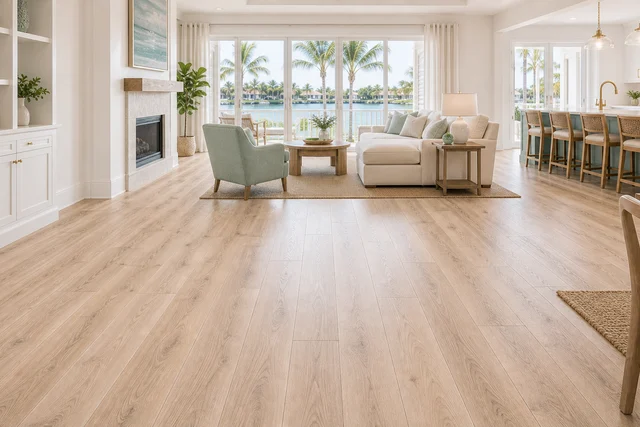
If one material rewrote the Florida market, it's waterproof luxury vinyl plank. Modern LVP carries a photographic-grade wood look over a rigid core the manufacturers build to be fully waterproof — spilled coffee, dripping swimsuits, an August of high humidity, none of it registers on a properly specified plank. It gives you the warmth of wood for the eye and none of the anxiety for the household, which is why it runs wall-to-wall through so many Southwest Florida homes now.
One honest note on the word "waterproof": that's a claim the plank manufacturers make about their cores, and the good ones back it — but the performance you actually get is decided as much by the installation as by the box. Slab moisture read up front, leveling where Florida concrete needs it, the right underlayment for the room: that's the part a showroom answers for, and it's the difference between a floor that's waterproof by design and one that's waterproof on the brochure.
Tile: The Coastal Native
Florida is one of the biggest tile markets in the country, and the logic is right there on the floor. Porcelain tile simply ignores humidity, wet feet, sand, and sun — it's the closest thing to a material with no weaknesses in this climate. Large-format porcelain keeps grout lines sparse and rooms feeling calm and open; wood-look porcelain planks give you the grain without a moment's worry about water. If you want a floor you will genuinely never think about again, tile is the coastal native, and it's why it anchors so much of what we install from the flooring wall.
Hardwood That Actually Behaves in a Humid House
Plenty of transplants arrive attached to real wood, and you don't have to give it up — you have to specify it for the climate. Solid hardwood, the northern default, moves with humidity and is the plank most likely to cup or gap here. Engineered hardwood, built as a stable core under a real wood veneer, holds its shape through Florida's moisture swings far better, and earns the bedrooms and studies where you want warmth that waterproof plank can't quite fake. The best wood floor in Florida is the one engineered for Florida in the first place — not the one that behaved somewhere drier. And if you're set on the look of solid oak or hickory, engineered versions of the same species get you most of the way there with none of the seasonal drama — a distinction most people can't feel underfoot once the floor is down.
The Indoor-Outdoor Question Northerners Don't Think to Ask
One decision that catches transplants off guard is the threshold — where the indoor floor meets the lanai. Up north, inside and outside are firmly separate; here, the sliders open ten months a year and the back of the house lives as one space. The floors can acknowledge that or fight it. Sometimes the right move is the same porcelain running straight through the slider line, so the living room and lanai read as one generous room; sometimes it's a paired tone across two materials, each rated for its own exposure. Either way it's worth deciding on purpose rather than by accident — the transition is the first thing your eye reads every morning, and it's the detail that makes an open Florida floor plan feel deliberate instead of stitched together.
The Shortcut Every Transplant Should Take
Here's the move that saves the most regret: don't decide the whole house from a website, and don't assume the northern answer transfers. Bring your room list to the showroom and walk it room by room — what stays tile, what earns engineered wood, where waterproof plank quietly wins, which one bedroom still wants carpet. Samples that look identical on a screen behave completely differently against your own light and your own habits, and the fastest way to spec a Florida house right is to put your hands on the materials before you commit to them.
That's a conversation we have all the time with people three weeks off a moving truck, and we enjoy it. Come into the Bonita Springs showroom with your list, or book a free in-home consultation and we'll read the actual rooms — the sun they get, the doors they open onto — and match the floor to the way Southwest Florida living really works.