
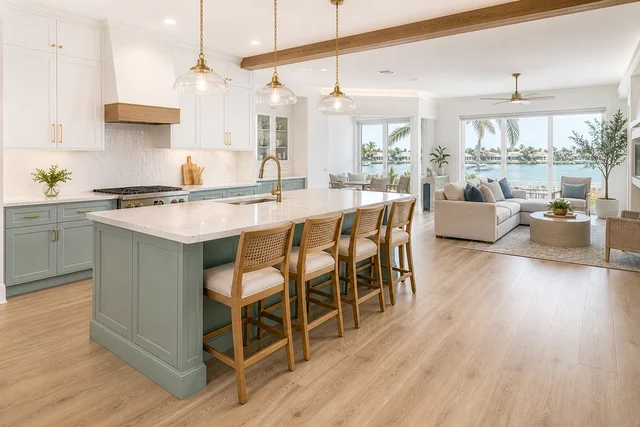
You probably came looking for a number — what a kitchen, a bath, or a countertop "should" cost. Here's the more useful thing to walk away with, because it's the skill that actually protects your budget: two quotes for what looks like the same job can land thousands apart, and the number is never the story — how the number is built is the story. Learn to read a quote and you stop wondering whether you're overpaying, because you can see it.
At Classic Floors & Countertops we break a quote into its parts on purpose, and part of the reason is that it makes our quotes easy to compare against anyone else's. So whether you buy from us or not, here's how to read what lands in your inbox — and where the cheap-looking one usually isn't.
Why a Single Lump Sum Hides More Than It Shows
The first thing to check isn't the total — it's whether the quote is itemized at all. A remodel handed to you as one big number, with no breakdown, is asking you to trust rather than to understand. A lump sum isn't a convenience; it's a place for things to hide. You can't tell what grade of material you're getting, what the labor actually costs, or what got quietly left out to make the bottom line look friendly. The fix is simple and you're allowed to insist on it: ask to see the number broken into its parts.
The Lines a Real Quote Breaks Out
A quote you can steer separates the pieces so each one is visible and swappable. On a countertop, for instance, you should see the material, the fabrication, the edge work, and the installation as their own lines — that's exactly how we build a countertops quote, so you can see what the stone costs versus what turning it into a finished counter costs. On a larger remodel, expect the major elements — cabinetry, surfaces, flooring, labor — each on their own line, plus the unglamorous but critical ones: demolition, site protection, prep work, and disposal. When every choice sits on its own line, you can move money toward what you care about instead of finding out too late where it went.
Where a Suspiciously Cheap Quote Hides the Savings
A low number is not automatically a good deal — often it's the same job with something removed, and it's usually removed from the part you can't see. In Southwest Florida the classic example is the wet area: a bathroom or shower quote that skips a proper bonded waterproofing system behind the tile can come in lower and cost far more later, because the failure happens inside the wall. Prep is the other common casualty — skipping slab moisture testing or floor leveling saves a line on the quote and shows up as a failing floor in a couple of years. The savings in a lowball quote almost always come out of the parts that don't show at the reveal but decide how the room ages. When two quotes are far apart, the honest question isn't "why is that one so expensive" — it's "what did the cheaper one leave out."
The Schedule Is Part of the Quote
A price without a plan is only half an answer. A quote worth signing should come with a written schedule — when the work starts, roughly what happens in what order, and when you get the room back. It won't predict the weather or what's behind a fifty-year-old wall, and a good one tells you that honestly. But a timeline in writing you can plan around beats a cheerful verbal promise you have to hope for, and a contractor willing to put dates on paper is telling you something about how they run a job.
The "We'll Figure It Out Later" Trap
Watch for allowances — placeholder dollars for a decision not yet made, like "tile allowance" or "appliance allowance." Allowances aren't dishonest; they're normal for choices you haven't finalized. But they're where a friendly-looking total quietly balloons, because the placeholder is often set low. The move is to nail down the big selections early, or at least to ask what a realistic allowance for your taste looks like, so the number in front of you resembles the number at the end. Every "we'll sort it out later" line is a decision deferred to a moment when you have less leverage, not more.
Deposits, Draws, and When Money Changes Hands
The payment schedule tells you almost as much as the price. A normal remodel is paid in stages tied to progress — a deposit to order materials and get on the calendar, one or more draws as milestones are hit, and a balance held until the work is genuinely finished and you've walked it. What you want to see is that the money follows the work, not the other way around.
The pattern to be wary of is a large share of the total due up front, before materials are ordered or a crew is scheduled. A deposit funds real costs — cabinetry and stone often have to be paid for before they can be ordered — so some money up front is normal and fair. But a contractor asking for half or more before anything happens is asking you to finance their business, and it removes the leverage that keeps a job moving: the balance you still hold is the reason the last ten percent of the work — the punch list, the fussy details — actually gets finished.
Ask, plainly: what's the deposit, what triggers each payment after it, and what's held until completion? A contractor who has run honest jobs has a clean answer ready, because the schedule is the same on every one. A vague answer, or pressure to pay ahead of the work, tells you more than any line on the quote — it's a preview of how the whole relationship will run.
When Two Quotes Are Far Apart
The most useful thing you can do with two very different numbers is stop treating the gap as a mystery and start treating it as a question with an answer. Nine times out of ten the difference lives in one of three places: the grade of material (a builder-basic cabinet box versus a plywood one, an entry stone versus a premium slab), what "installation" actually includes (is demolition in there? disposal? the unglamorous prep work?), and how much of the wet-area or structural work is done right versus done cheap. Line the two quotes up part against part and the gap usually explains itself — and the cheaper number often turns out to be the more expensive one a year later, once the corner that got cut starts to show.
The Questions Worth Asking Before You Sign
Whoever you hire, get clear answers to these first:
- Is the quote itemized, and can I see the major elements and the labor as separate lines?
- What waterproofing and prep are included — specifically — for any wet area or new floor?
- Is there a written schedule, and what happens if the job uncovers a surprise?
- Which numbers are firm and which are allowances, and how were the allowances set?
- Who is my single point of contact from start to final walkthrough?
A contractor comfortable with those questions is one whose quote you can trust. A contractor who changes the subject has answered them, too.
The real reason to learn this is that it turns price shopping from a guessing game into a fair comparison. When you can read the lines, you stop chasing the lowest number and start choosing the honest one. Bring a quote you've received to the Bonita Springs showroom and we'll walk it with you line by line — or start a kitchen remodel with us and see what a quote you can actually read looks like.