
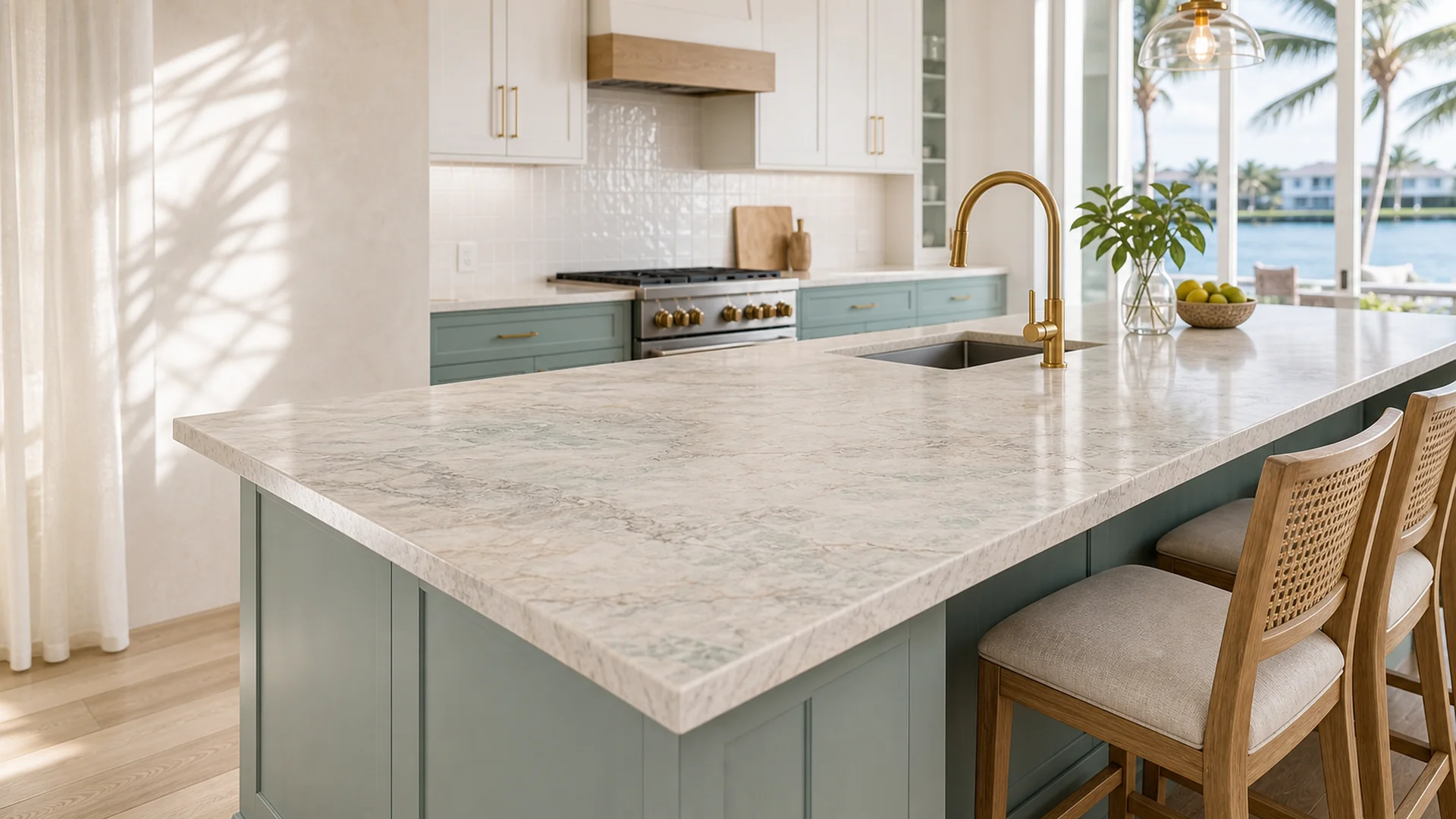
No two countertop materials get confused for each other more than quartz and quartzite — one letter apart on the label, right next to each other on the sample wall, and fundamentally different things. One is engineered in a factory; the other was engineered by geology. Choosing between them is the most common fork in the road in our countertop conversations, so here is the whole comparison, the way we give it across the counter.
What each one actually is
Quartz is a manufactured surface: ground natural quartz crystals bound in resin and pigment, formed into slabs. Because it's engineered, it's consistent — the slab you saw in the showroom is the slab that arrives — and it's nonporous straight from the factory. Brands like Cambria and Silestone have spent decades refining the recipe, and the current generation of patterns imitates marble convincingly enough to fool people who own marble.
Quartzite is natural stone: sandstone transformed by heat and pressure into one of the hardest surfaces geology sells. Every slab is one of one — veining, movement, and translucency no factory can print. It arrives porous enough to want sealing, and its personality is exactly that wildness: dramatic veins, watercolor washes, depth that changes with the light.
The confusion is understandable — quartzite is largely quartz, mineralogically — but in your kitchen they behave differently in precisely the ways that matter.
Durability and heat
Both stand up to everyday knife-and-pan life; scratching either takes real effort. Heat is where they diverge. Quartzite is stone through and through — a hot pan is a nonevent. Quartz's resin binder is the limit: sustained high heat can scorch or discolor it, so trivets aren't optional, they're the manual. If your cooking style involves sliding pans off the burner onto the counter without thinking, that habit alone is an argument for quartzite. Chips behave similarly in both — rare, edge-focused, repairable — though quartzite's crystalline structure can be more prone at delicate mitered edges, which is a fabrication-quality conversation more than a material one.
Maintenance and sealing
Here the argument flips. Quartz is the low-maintenance champion: nonporous, never sealed, cleaned with soap and water — the whole regimen fits in one sentence, and we've written it up in our quartz care guide. Quartzite wants a penetrating sealer on installation and a re-seal on a recurring basis depending on the stone and use — a ten-minute wipe-on job, but a job. Skip it, and oils and wine can shadow the surface. Choose quartz to never think about your countertop; choose quartzite to think about it once a year in exchange for a one-of-one slab. Neither answer is wrong; they're different owners.
The looks — consistency versus theater
Quartz's patterns are designed, which is either its superpower or its ceiling depending on your taste: perfect repeatability, tight color control, a match to any cabinet palette, and — in the best lines — marble looks without marble anxiety. Quartzite is theater: Taj Mahals with their soft washes, Fusion-style slabs that read like weather systems, crystalline whites that glow at the edges. In the coastal palettes Southwest Florida loves — pale woods, seafoam, white oak, brass — both families have natural homes; the difference is whether you want the counter to harmonize quietly or headline. Our advice never changes: never pick either from a four-inch sample — veining is a full-slab story, and the slab you fall for should be the slab that gets templated.
Where granite still fits
The classic third option hasn't gone anywhere. Granite remains a durable, heat-proof, honest value — often the budget-friendliest of the three — with its own genuine beauty, particularly in the darker and speckled families quartz doesn't imitate well. It shares quartzite's sealing routine. If the veined-marble look is what you're after, quartz and quartzite own that territory; if you want proven stone at a friendly number, granite deserves its place in the comparison. All three live side by side on our countertop wall, priced as installed projects rather than mystery square-footage.
Cost, briefly
The two families overlap broadly in price. Entry quartz typically undercuts entry quartzite; exotic quartzite tops the chart, with premium designer quartz close behind. Fabrication choices — edge profiles, cutouts, waterfall panels — move the number as much as the material does. For a typical kitchen, the honest summary is that you choose between these materials on behavior and beauty, not budget; the budget conversation is really about slab tier and fabrication, and it happens the same way for both.
The five-question shortcut
- Do hot pans land on the counter in your house? Quartzite forgives; quartz keeps score.
- Will you actually re-seal a counter once a year? Be honest — if not, quartz.
- Do you want the counter to match the design, or be the design? Consistency says quartz; theater says quartzite.
- Is the slab going near a wall of west-facing glass or outdoors? Natural stone handles serious sun better.
- Are two islands or a big L involved? Pattern-matching seams is easier in engineered material; celebrating a dramatic vein across a seam is a quartzite art.
Most people know their answer by question three. The showroom exists for the ties.
Fabrication: where both materials are won or lost
Whichever family you choose, the fabrication decisions travel with you. Edge profile — eased, mitered, bullnose — changes both look and price. Seam placement deserves a conversation over the actual slab layout, not a surprise at install. Thickness reads instantly: 3cm carries visual weight that 2cm doesn't. Sink cutouts, faucet drilling, and backsplash returns each add small lines to the quote. This is also where installer quality shows: tight seams, supported overhangs, and level runs are craft, not luck — and one accountable team, working the backsplash tile and the stone above it together, is the difference between a slab and a finished kitchen.
What we actually see chosen here
Pattern from over 20 years of Southwest Florida kitchens: quartz wins the working kitchen — families, rentals, anyone allergic to maintenance — and it wins most vanities, where its chemistry resistance meets cosmetics and toothpaste. Quartzite wins the showpiece island, the great-room kitchen where the counter is the art, and the homes where a hot-pan habit is non-negotiable. Plenty of projects split the difference deliberately: a dramatic quartzite island framed by quiet quartz perimeter runs — theater where you look, armor where you work. Outdoors, neither is our first call; that conversation belongs to granite and dense stone on the outdoor kitchen page. And on resale: buyers ask for "stone counters" — both families answer the question, so choose for how you live, not for an imagined appraisal.
What about cost?
The honest short version: quartz and quartzite overlap more than people expect, and the spread within each family is wider than the gap between them. An entry-level quartz and a premium quartzite are worlds apart; a high-end quartz and a modest quartzite can land in the same neighborhood. What actually moves your number is the specific slab, the square footage, the edge profile, and the fabrication — which is why a range pulled off the internet tells you almost nothing about your kitchen. Granite, the third option, is often the friendliest of the three on price while giving up nothing on durability, which is worth remembering when the veined-marble look isn't the goal. We'll walk through what each choice does to the price so you're comparing real options, not averages.
Choose it in person
This is the decision the internet genuinely cannot make for you. Colors lie on screens; veining lies in thumbnails; and the feel of a leathered quartzite versus a polished quartz is a fingertip fact. Come stand at the sample wall in Bonita Springs, put the finalists next to your cabinet door and tile, and the winner usually announces itself in about ten minutes. Then we template, fabricate, and install it — one team, the price talked through, and quick once the slab is cut. If the counter is part of a bigger picture, the kitchen remodeling team works from the same showroom, the same materials in hand.